
AI receptionist benefits for your trade business
Discover the ai receptionist benefits for trade business: 24/7 call handling, significant cost savings, and no more missed opportunities!
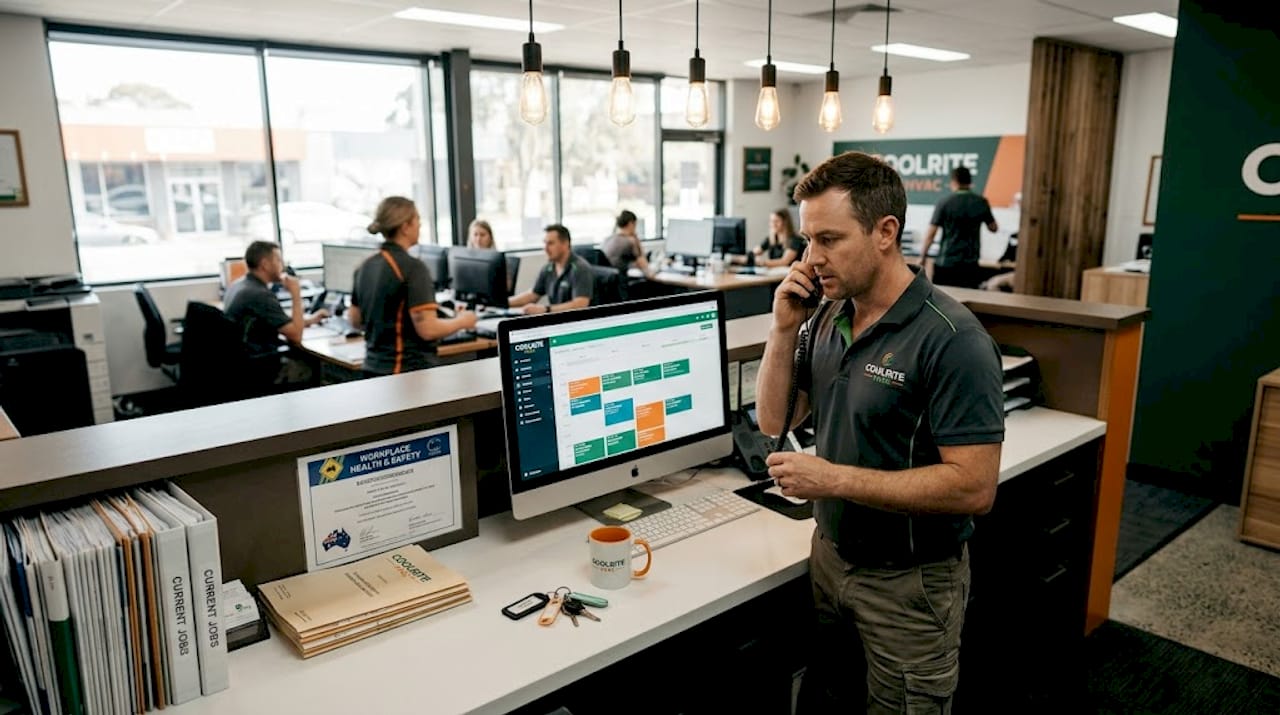
AI receptionist benefits for your trade business
You’re up a roof cavity at 2pm, sweating through your shirt, and your phone is ringing off the hook. You can’t answer it. By the time you climb down and call back, that customer has already booked someone else. That scenario plays out in trade businesses every single day, and the cost adds up fast. Understanding the ai receptionist benefits trade business owners can actually use, versus what sounds good in a brochure, is what separates businesses that grow from ones that stay stuck chasing voicemails. This article breaks it all down practically, so you can decide what’s worth your time and money.
Table of Contents
Key takeaways
What to look for in an AI receptionist for a trade business
How to evaluate the criteria above
Top AI receptionist benefits for trade businesses
1. Fewer missed calls, more revenue captured
2. Faster response times that win jobs
3. Handling multiple calls at once during peak periods
4. Significant cost savings over human staff
5. Emergency call capture that pays for itself instantly
6. Automated scheduling that frees up your team
7. Consistent, professional first impressions every time
8. Scalability as your business grows
9. Call analytics that improve your business over time
10. A hybrid model that covers every situation
AI receptionists versus traditional and virtual options
How to decide what AI receptionist benefits matter most to your business
My honest take on AI receptionists for trade businesses
See how Servicemagnet handles calls for trade businesses
FAQ
Key takeaways
Point | Details |
|---|---|
Missed calls cost real money | One captured emergency call can pay for an entire month of AI receptionist service. |
AI answers 24/7, no exceptions | Calls are handled after hours, on weekends, and during peak job times without extra staff costs. |
Cost savings are significant | AI receptionist services start around $500 per month versus $30,000-plus annually for a human employee. |
Lead conversion improves fast | Response times dropping from hours to seconds push conversion rates from 49% up to 70%. |
Hybrid models work best | Around 20% of calls still benefit from human follow-up, so AI and humans work well together. |
What to look for in an AI receptionist for a trade business
Before you invest in any technology, it pays to know what you actually need. Not all receptionist AI solutions are built for the realities of trade work, and picking the wrong one will frustrate your customers fast.
Here are the criteria that matter most for trade businesses:
Reliability and uptime. Your AI receptionist needs to answer every single call, whether it is 7am on a Monday or 11pm on a Saturday. Trades get emergency calls at all hours. If the system drops out, you lose the job.
Natural conversation quality. Customers ringing about a burst pipe or a faulty switchboard are already stressed. They need to feel like they are talking to someone who understands them, not a clunky phone tree. Look for systems with genuine natural language understanding.
Scheduling and CRM integration. The real value of trade business automation comes when the AI books jobs directly into your calendar and logs customer details without your admin team lifting a finger.
Lead capture and triage. Can the system identify an emergency call versus a general enquiry and route it accordingly? This matters enormously for plumbers, electricians, and HVAC contractors.
Cost-effectiveness. Employee benefits add roughly 30% on top of a receptionist’s base salary. The AI alternative needs to stack up clearly against that total figure.
Privacy and compliance. Make sure any system you use handles customer data in line with Australian Privacy Act requirements, particularly if you are storing sensitive booking or payment information.
Pro Tip: Ask any provider to demonstrate the system with a real trade-scenario call before you sign anything. Run a test call about an after-hours hot water emergency and see how it handles triage and booking.
How to evaluate the criteria above
Think about your own business for a moment. When does your phone ring the most? For most trade businesses, it is during the exact hours you are physically on the tools and cannot answer. That gap between ringing phones and available hands is where AI receptionists do their best work.
A good starting point is tracking your missed calls for two weeks. Look at what time of day they happen, how many go to voicemail, and how many of those callers actually follow up. The gap in that data is your lost revenue number.
Top AI receptionist benefits for trade businesses
Here is where it gets concrete. These are the benefits that genuinely move the needle for trade businesses, not just theoretical efficiency gains.
1. Fewer missed calls, more revenue captured
The phone rings while you are under a house running new ductwork. You miss it. That call might have been a $2,000 ducted system install. AI receptionists reduce missed calls by 75%, and for trade businesses, that directly translates to more booked jobs and more revenue. Small businesses report a 300% first-year ROI after adopting AI reception, with a 25% lift in bookings. That is not a rounding error. That is a real business shift.
2. Faster response times that win jobs
Speed wins in trade services. When someone’s hot water system fails or their air conditioner dies in a heatwave, they call three businesses and book the first one that responds. Lead conversion rates improved from 49% to 70% when response times dropped from up to 48 hours down to under 30 seconds. Your AI receptionist picks up immediately, every time. That speed alone is one of the strongest virtual receptionist advantages in competitive trade markets.
3. Handling multiple calls at once during peak periods
Summer hits and suddenly every air conditioning unit in the suburb decides to fail on the same Tuesday. Your phone rings non-stop and your one office staff member cannot keep up. An AI receptionist handles unlimited simultaneous calls without putting anyone on hold. There is no busy signal. No “I’ll have to call you back.” Every caller gets answered, every job gets captured.
4. Significant cost savings over human staff
This is where the numbers speak loudly. Employer benefits alone cost between $20,000 and $30,000 annually per employee, on top of wages. A blended AI receptionist service starts around $500 per month, which works out to $6,000 per year. The saving is not marginal. It is the kind of number that changes what you can afford to invest elsewhere in your business.
5. Emergency call capture that pays for itself instantly
One of the most underestimated AI customer service benefits for trade businesses is emergency call capture. A single after-hours plumbing emergency or an urgent electrical fault can be worth anywhere from $500 to several thousand dollars. One emergency call handled by AI easily pays for the monthly service cost. If you are spending $500 a month and capturing just one job you would have otherwise missed, the AI has already paid for itself. Everything after that is profit.
“The best trade businesses use AI receptionists not just to cut costs, but as a revenue-capture tool focused on the calls that lead to high-value contracts.” — Industry ROI research
6. Automated scheduling that frees up your team
When your AI receptionist integrates with your scheduling and CRM tools, it does not just take a message. It books the job, updates your calendar, logs the customer’s contact details, and sends a confirmation. Your admin person stops spending three hours a day re-entering information from voicemails. That time goes back into quoting, invoicing, and chasing payments instead.
7. Consistent, professional first impressions every time
Your brand is built on every customer interaction, not just the quality of your work. When a customer rings and gets a clear, professional, helpful response at 6am on a Sunday, that sets the tone for the whole job. Consistent AI in customer interactions removes the variability you get with different staff answering calls differently, or no one answering at all.
Pro Tip: Use custom scripts that mention your business name, your service areas, and your speciality trades in the AI’s greeting. A plumber in Brisbane sounds more credible than a generic “we handle all jobs” response.
8. Scalability as your business grows
You take on two new apprentices, win a commercial contract, and suddenly your call volume doubles. A human receptionist becomes a bottleneck. An AI receptionist scales with zero friction. You do not recruit, train, or manage it. The benefits of virtual staff in this context are real: the system handles more volume without any change to its cost structure or performance quality.
9. Call analytics that improve your business over time
Every call handled by an AI system generates data. You can see what times you receive the most calls, what types of jobs are enquiring most, what your busiest days are, and where callers are dropping off. This is information most trade businesses never had access to before. Use it to plan rosters, adjust marketing, and identify which services generate the highest call volume.
10. A hybrid model that covers every situation
Around 20% of AI receptionist calls still require human involvement, and the best providers build for this. Complex calls, disputes, or emotionally charged situations can be flagged and transferred to you or your team. AI handles the volume. You handle the nuance. That balance is what makes improving trade business efficiency with AI actually work in the real world, rather than creating frustrated customers who feel they cannot reach a real person.
AI receptionists versus traditional and virtual options
How does an AI receptionist actually compare to the alternatives? Here is a straightforward look.
Feature | AI receptionist | Human receptionist | Traditional virtual service |
|---|---|---|---|
Availability | 24/7, no exceptions | Business hours only | Extended hours, not always 24/7 |
Monthly cost | From $500 | $3,000-plus plus benefits | $1,000-$2,500 per month |
Simultaneous calls | Unlimited | One at a time | Limited by agent availability |
CRM integration | Automatic | Manual entry | Varies by provider |
Consistency | Always the same | Depends on the person | Varies by shift and agent |
Lead qualification | Built-in | Depends on training | Often limited |
The cost-saving AI receptionist advantage is clear in that table. But beyond cost, 67% of customers book with the first business that responds to their enquiry. Human receptionists on a lunch break and traditional virtual services with queues simply cannot compete with an AI that picks up in under two seconds, every time.
For trade-specific context on how this plays out in practice, the experience of AI for plumbing businesses shows exactly how admin load drops when scheduling is automated end to end.
How to decide what AI receptionist benefits matter most to your business
Not every benefit will hit equally for every trade business. Here is how to prioritise:
Calculate your missed call rate first. Pull your call logs and voicemails from the past month. Estimate the average job value and multiply by the missed calls. That number tells you how urgent this is.
Identify your worst time windows. If you regularly miss calls between 7am and 8am before the office opens, or after 5pm when your team knocks off, those windows are your biggest opportunity.
Start with after-hours coverage. This is the lowest-risk way to pilot AI reception. You keep your human staff for business hours and let the AI cover the gaps. You will see results quickly.
Match the features to your pain points. If your main problem is emergency call triage, prioritise that. If it is appointment booking volume, focus on scheduling integration. Do not pay for features you will not use.
Plan how you will measure success. Set a target before you start. For example, reduce missed calls by 50% in 90 days, or capture two additional jobs per week from after-hours calls.
Pro Tip: For HVAC businesses specifically, AI for HVAC contractors shows how much seasonal peak volume can be managed without hiring temporary staff each summer.
My honest take on AI receptionists for trade businesses
I’ve worked with trade businesses long enough to know where the scepticism comes from. You’ve seen tech solutions that sounded good in a demo and fell apart on the job. I get it.
But here’s what I’ve seen happen with AI receptionists when they’re set up properly. The businesses that treat them purely as a cost-cutting measure often get modest results. The businesses that treat them as a revenue-capture tool, where every missed call represents a real dollar amount, they see the ROI clearly within the first 30 days.
The workforce challenges in HVAC and plumbing trades are real. Hiring is hard, retention is harder, and expecting a good tradesperson to also be a reliable phone answerer is a recipe for frustration. AI does not fix your people problems, but it does remove one of the biggest sources of lost revenue that your people problems create.
My advice: don’t start by trying to replace your receptionist if you have a good one. Start by asking what calls are currently falling through the cracks, especially after hours and during peak periods. That’s where the money is sitting uncaptured. A hybrid approach, AI for volume and overflow, human for complexity, is what actually holds up in the real world.
— Service
See how Servicemagnet handles calls for trade businesses
If you’re a trade business owner tired of missed calls turning into missed revenue, Servicemagnet’s AI voice agents are built specifically for this. The system answers every call 24/7, books appointments directly into your calendar, and handles your after-hours enquiries with professional, trade-specific scripts. Setup is straightforward, and the integration with your existing scheduling tools is handled for you.
Pricing starts from $500 per month, which for most trade businesses means a single captured job covers the cost. There’s no complex onboarding and no lock-in pressure. You can explore the full features and see exactly how Servicemagnet works for businesses like yours at servicemagnet.ai. If you are an electrician wanting trade-specific context, the AI for electricians page walks through the ROI in detail.
FAQ
What are the main AI receptionist benefits for trade businesses?
AI receptionists answer every call 24/7, book appointments automatically, and capture emergency enquiries that would otherwise go to voicemail. Trade businesses typically see a 75% reduction in missed calls and a 25% increase in bookings after adoption.
How much does an AI receptionist cost compared to a human receptionist?
AI receptionist services start from around $500 per month, while a human receptionist costs $30,000 or more annually once you factor in benefits adding 30% to base salary. The cost difference is substantial for most small to medium trade businesses.
Can an AI receptionist handle emergency trade calls?
Yes. Well-configured AI receptionists can identify urgent calls, gather key details, and either book immediately or escalate to an on-call tradesperson. One emergency job captured can pay for the entire monthly service cost, making emergency call handling one of the strongest return-on-investment use cases.
Do AI receptionists fully replace human staff?
Not entirely, and the best systems are not designed to. Around 20% of calls benefit from human follow-up, particularly complex or emotionally sensitive enquiries. The most effective approach combines AI for routine call volume with human staff managing situations that need judgement.
How quickly can a trade business set up an AI receptionist?
Most providers, including Servicemagnet, offer setup within a few days. You provide your business details, service areas, and preferred scripts, and the system goes live. You can start with after-hours coverage only to test the results before expanding to full-time coverage.